
How to Date Antique Jewelry: An Expert Guide to Identifying Eras

Identifying the age of a ring or pendant is a detective’s task. A single clue—like a hallmark or a stone cut—is rarely enough. To date antique jewelry accurately, you must analyze the "design language," construction methods, and gemstone cuts as a cohesive whole.
Whether you are a collector or a first-time buyer, precise dating affects value, durability, and authenticity. Here is how to distinguish a genuine Georgian heirloom from an Art Deco masterpiece.

1. Dating by Era and Construction
True antique jewelry (18th to early 20th century) shows signs of hand-finishing that modern reproductions cannot convincingly replicate. Under magnification, look for subtle irregularities: asymmetrical galleries, hand-pierced metal, and period-specific hinges.
Key Historical Eras:
Georgian (1714–1837): Extremely rare. Look for closed-back settings, foiled gemstones, and silver-topped gold. Pieces feel intimate and purely handcrafted.
Victorian (1837–1901): A vast era. Early pieces feature serpent motifs and seed pearls; later "Grand" styles use dark onyx and jet; Late Victorian jewelry becomes lighter, introducing star settings and crescents.
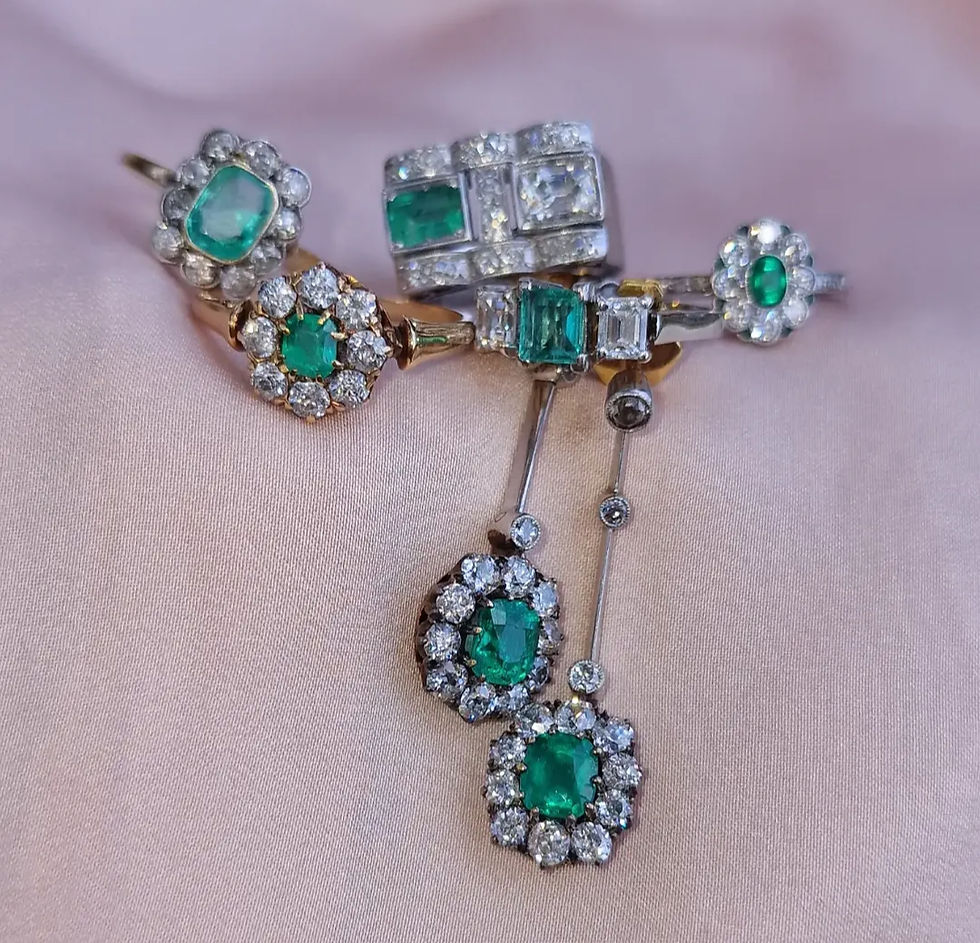
Edwardian (1901–1915): The era of refinement. Platinum allowed for "lace-like" openwork, milgrain edges, and bow motifs.
Art Deco (1920s–1930s): Defined by geometry and architecture. Look for calibré-cut accents, stepped forms, and strong linear contrasts.

2. The Details That Reveal Age
If you want to know how to date antique jewelry without relying on seller labels, focus on these three technical pillars:
A. Gemstone Cuts
Stone cuts travel through time, but they are excellent indicators of a stone's origin:
Rose Cuts & Old Mine Cuts: Point to earlier, pre-Victorian periods.
Old European Cuts (OEC): The hallmark of Late Victorian to early Art Deco. They feature a high crown, small table, and a visible culet.
Modern Brilliants: If a "Victorian" ring has a perfectly symmetrical modern brilliant-cut diamond, it is likely a later replacement or a reproduction.
B. Metal Use
Silver-topped Gold: Common before the mid-19th century.
Yellow Gold: Dominant throughout the 1800s.
Platinum: A signature of the Edwardian era.
White Gold: Generally indicates a date of 1920 or later, as it only rose to commercial popularity after WWI.
C. Settings and Findings
The underside of a piece often tells the truest story. Antique rings feature hand-fabricated galleries, while brooches might have C-clasps or tube hinges that extend beyond the edge.
3. Common Pitfalls: Style vs. Period
A common mistake in the jewelry trade is confusing "period style" with "period piece."
Expert Tip: A ring made in the 1970s in an Edwardian "revival" style may be beautiful, but it is not an antique. The difference lies in the manufacture, not just the look. Look for the softness of antique patina versus the sharp, uniform finish of modern casting.
Does Provenance Matter?
Inscriptions and original boxes add context, but physical evidence is king. A date engraved in 1908 is only meaningful if the construction and stone cuts align with Edwardian techniques.
Summary: Building Your Collector’s Eye
At Old Cut Jewellery, we believe a genuine antique jewel shouldn’t need a romantic story to feel convincing. Its era should be written in the metal, the cut of the stones, and the soul of its assembly.
Developing a patient eye for these details is the best way to buy with confidence. When a piece is authentic, all the clues—from the culet of the diamond to the patina of the gold—will eventually agree.


Comments